
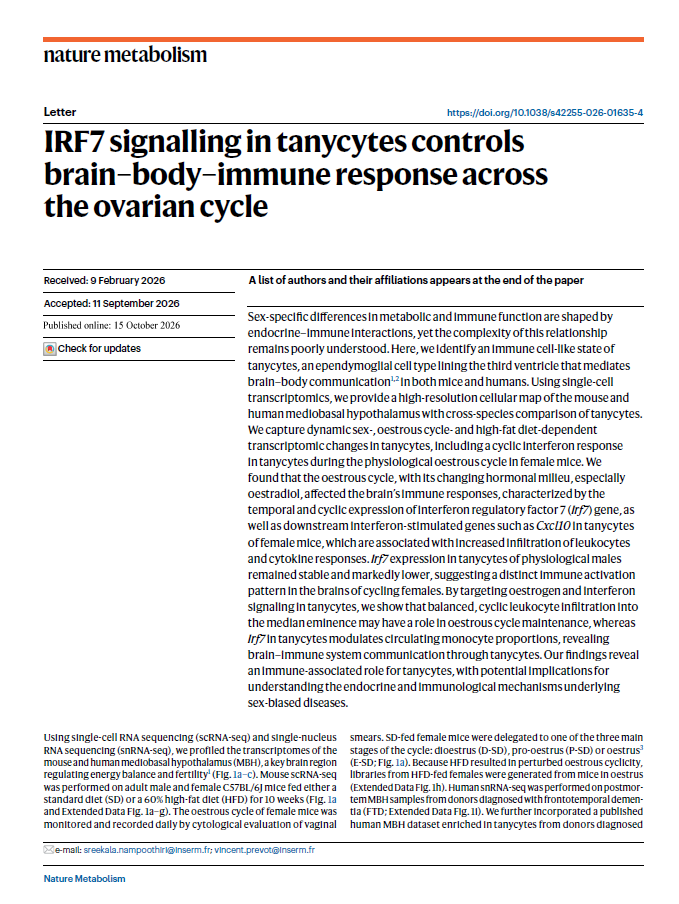
On October 15, 2026, Vincent Prévot’s team from the InEndo consortium published an article titled “IRF7 signaling in tanycytes controls brain–body–immune response across the ovarian cycle” in the journal Nature Metabolism.
The mediobasal hypothalamus is a key brain region involved in regulating energy balance and fertility. Among the cells involved in these functions, tanycytes facilitate communication between the brain and the rest of the body.
In this study, the authors used single-cell transcriptomics to create a high-resolution cellular map of this region in mice and humans. Dynamic transcriptomic changes dependent on sex, the ovarian cycle, and a high-fat diet were identified in tanycytes. In female mice, these cells exhibit a cyclical response to interferon throughout the ovarian cycle.
The ovarian cycle affects immune responses in the brain, characterized, among other things, by the expression of the interferon regulatory factor 7 (Irf7) gene. This expression is associated with increased leukocyte infiltration and cytokine responses.
These findings show that a balanced, cyclical leukocyte infiltration in the median eminence may play a role in maintaining the ovarian cycle, while Irf7 present in tanycytes modulates the proportions of circulating monocytes, thereby revealing communication between the brain and the immune system via tanycytes.
These findings, along with the identification of the immune role of tanycytes, could lead to a better understanding of the endocrine and immunological mechanisms underlying sex-related diseases.
- Sreekala Nampoothiri, Université de Lille – Inserm – CHU Lille
- Daniela Fernandois, Université de Lille – Inserm – CHU Lille
- Nathalie Journiac, Université de Lille – Inserm – CHU Lille
- Fabien Delahaye, Université de Lille – Inserm – CNRS, Institut Pasteur de Lille, CHU Lille
- Yvon Mbouamboua, Université de Lille – Inserm – CHU Lille
- Florent Sauve, Université de Lille – Inserm – CHU Lille
- Marie Couralet, Université Côte d’Azur, CNRS, Inserm
- Sarah Gallet, Université de Lille – Inserm – CHU Lille
- Naziha Mroueh, University of Bonn
- Maria Laura Serradas Aponte, University of Bonn
- Nathalie Jouy, PLBS
- Rachel Spenle, Université de Lille – Inserm – CHU Lille
- Ruth Schmidt-Ullrich, Max-Delbrück-Centrum für Molekulare Medizin in der Helmholtz-Gemeinschaft
- Ines Martinez Corral, Université de Lille – Inserm – CHU Lille
- Virginie Mattot, Université de Lille – Inserm – CHU Lille
- Carmen Ruiz de Almodovar, University of Bonn
- Andreas Schlitzer, University of Bonn
- Philippe Froguel, Université de Lille – Inserm – CNRS, Institut Pasteur de Lille, CHU Lille
- Claude-Alain Maurage, Université de Lille – Inserm – CHU Lille
- Pascal Barbry, Université Côte d’Azur, CNRS, Inserm
- Paolo Giacobini, Université de Lille – Inserm – CHU Lille
- Lennart T. Mars, Université de Lille – Inserm – CHU Lille
- Amelie Bonnefond, Université de Lille – Inserm – CNRS, Institut Pasteur de Lille, CHU Lille
- Ruben Nogueiras, Universidade de Santiago de Compostela-Instituto de Investigation Sanitaria, CIBER
- Markus Schwaninger, University of Lübeck
- Vincent Prevot, Université de Lille – Inserm – CHU Lille