
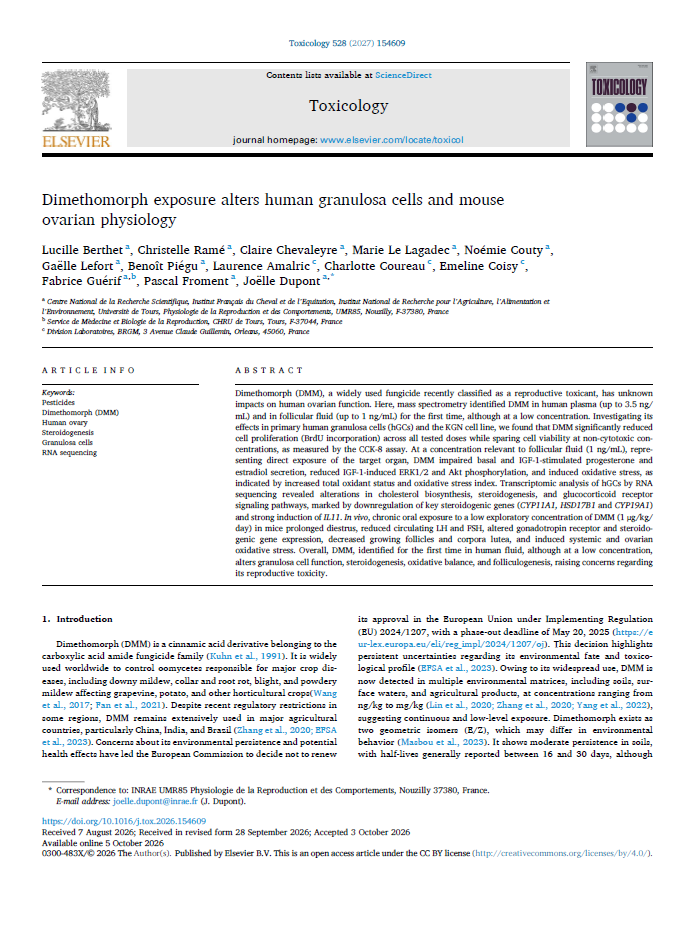
On October 5, 2026, the article titled “Dimethomorph exposure alters human granulosa cells and mouse ovarian physiology” was published in the journal Toxicology, with Lucille Berthet, a doctoral student funded by the PEPR SAFE program, as the first author.
imethomorph (DMM) is a fungicide used worldwide to control fungi that cause serious diseases affecting grapevines, potato crops, and other horticultural crops.
DMM was recently classified as a reproductive toxicant. Although its use will be phased out in the European Union by May 2025, DMM is still detected in soil, surface water, and agricultural products, suggesting ongoing low-level exposure among the general population.
In this study, the authors identified the presence of DMM in human plasma and follicular fluid. To investigate the effects of DMM exposure, in vitro studies were conducted on primary human granulosa cells and a human KGN cell line, as well as in vivo studies in mice. This research highlights alterations in:
- granulosa cell function
- steroidogenesis
- oxidative balance
- folliculogenesis
These results thus demonstrate the reproductive toxicity of DMM at concentrations comparable to those measured in human follicular fluid.
- Lucille Berthet, CNRS, IFCE, INRAE, Université de Tours
- Christelle Ramé, CNRS, IFCE, INRAE, Université de Tours
- Claire Chevaleyre, CNRS, IFCE, INRAE, Université de Tours
- Marie Le Lagadec, CNRS, IFCE, INRAE, Université de Tours
- Noémie Couty, CNRS, IFCE, INRAE, Université de Tours
- Gaëlle Lefort, CNRS, IFCE, INRAE, Université de Tours
- Benoît Piégu, CNRS, IFCE, INRAE, Université de Tours
- Laurence Amalric, BRGM
- Charlotte Coureau, BRGM
- Emeline Coisy, BRGM
- Fabrice Guérif, CNRS, IFCE, INRAE, Université de Tours – CHRU de Tours
- Pascal Froment, CNRS, IFCE, INRAE, Université de Tours
- Joëlle Dupont, CNRS, IFCE, INRAE, Université de Tours