
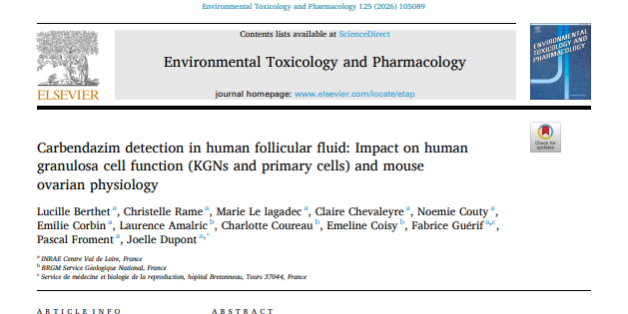
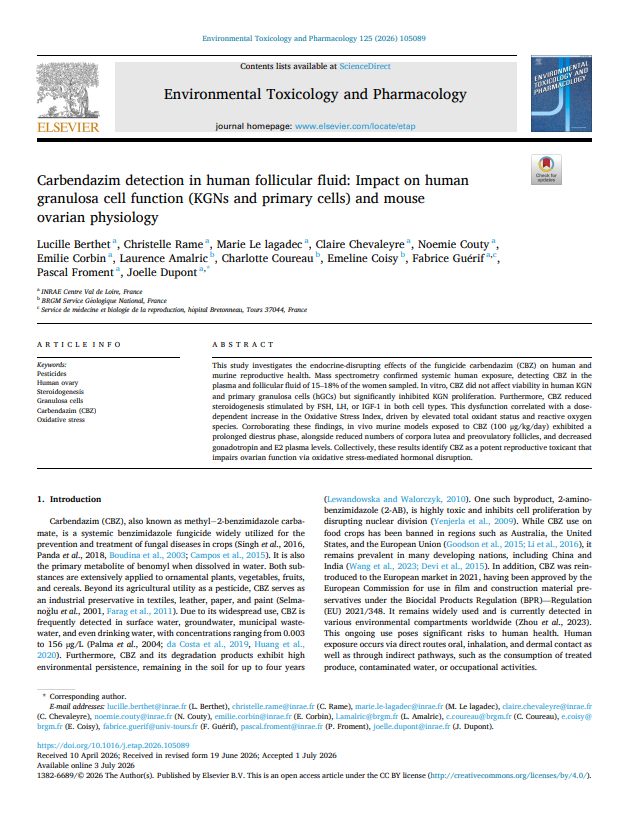
On July 3, 2026, the article titled “Carbendazim Detection in Human Follicular Fluid: Impact on Human Granulosa Cell Function (KGNs and Primary Cells) and Mouse Ovarian Physiology” was published in the journal Environmental Toxicology and Pharmacology, with Lucille Berthet, a PEPR SAFE PhD candidate, as the author.
Carbendazim (CBZ), found in water, is a fungicide widely used in the prevention and treatment of fungal diseases in crops. It is also used as a preservative in textiles, leather, paper, and paints. In 2021, its use as a preservative was reintroduced in Europe.
In this study, the authors examined the impact of CBZ exposure on reproductive health.
They show that, in humans, CBZ is detected in plasma and follicular fluid in 15 to 18% of the 60 women included in the study. Using a human granulosa cell line (KGN cells) and primary cells, they demonstrated a reduction in progesterone and estradiol production, as well as an increase in oxidative stress. In mice, oral exposure to CBZ confirmed these effects and disrupted the estrous cycle and folliculogenesis.
This study thus identifies a new toxic compound, CBZ, for human reproduction.
- Lucille Berthet, INRAE
- Christelle Rame, INRAE
- Marie Le Lagadec, INRAE
- Claire Chevaleyre, INRAE
- Noemie Couty, INRAE
- Emilie Corbin, INRAE
- Laurence Amalric, BRGM
- Charlotte Coureau, BRGM
- Emeline Coisy, BRGM
- Fabrice Guérif, INRAE, Hôpital Bretonneau
- Pascal Froment, INRAE
- Joelle Dupont, INRAE