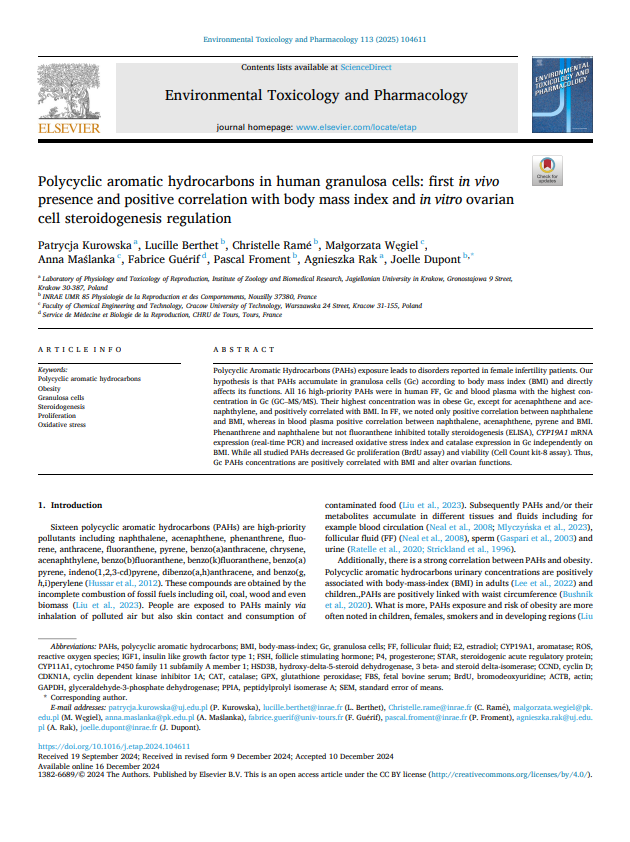
On December 16, 2024, the article titled “Polycyclic aromatic hydrocarbons in human granulosa cells: first in vivo detection and positive correlation with body mass index and in vitro regulation of ovarian cell steroidogenesis” was published in the journal Environmental Toxicology and Pharmacology, with Lucille Berthet, a PEPR SAFE PhD candidate, as the author.
Polycyclic aromatic hydrocarbons (PAHs) are a family of pollutants primarily resulting from the incomplete combustion of fossil fuels. The general population is exposed to them through inhalation of polluted air, as well as through skin contact or consumption of contaminated food. Exposure to PAHs is linked to the risk of obesity and has a direct impact on female reproduction, including reproductive disorders, imbalances in reproductive hormones, and adverse pregnancy outcomes.
In this study, the authors examined the impact of PAHs on ovarian cells in relation to the subjects’ body mass index (BMI).
The results highlight the presence of PAHs in all analyzed samples: skin, blood, and ovaries. In ovarian cells, PAH concentrations increase with higher BMI and reduce cell proliferation. Furthermore, certain PAHs inhibit steroidogenesis and induce oxidative stress in these cells.
This study thus highlights the positive correlation between PAH concentration and BMI, as well as the impairment of ovarian function caused by these pollutants.
- Patrycja Kurowska, Jagiellonian University in Krakow
- Lucille Berthet, INRAE
- Christelle Ramé, INRAE
- Małgorzata Węgiel, Cracow University of Technology
- Anna Maślanka, Cracow University of Technology
- Fabrice Guérif, CHRU de Tours
- Pascal Froment, INRAE
- Agnieszka Rak, Jagiellonian University in Krakow
- Joelle Dupont, INRAE